Public safety
Hazard Trees & ROW Management
Identify and prioritize risk trees along roads, trails, and recreation
areas so crews can work safely and budgets go where they matter most.
Not every leaning tree is an emergency, and not every budget can treat
it like one. We rank risk by what's actually likely to fail and what
it would hit if it did, so a limited hazard-tree budget goes to the
trees that matter, not the ones that just look bad.
- Roadside and trail-corridor risk tree survey
- Prioritized removal list tied to real failure risk
- Support for capital planning and budget requests
- Coordination with road agents and tree crews
Recreation & habitat
Town Forest & Park Planning
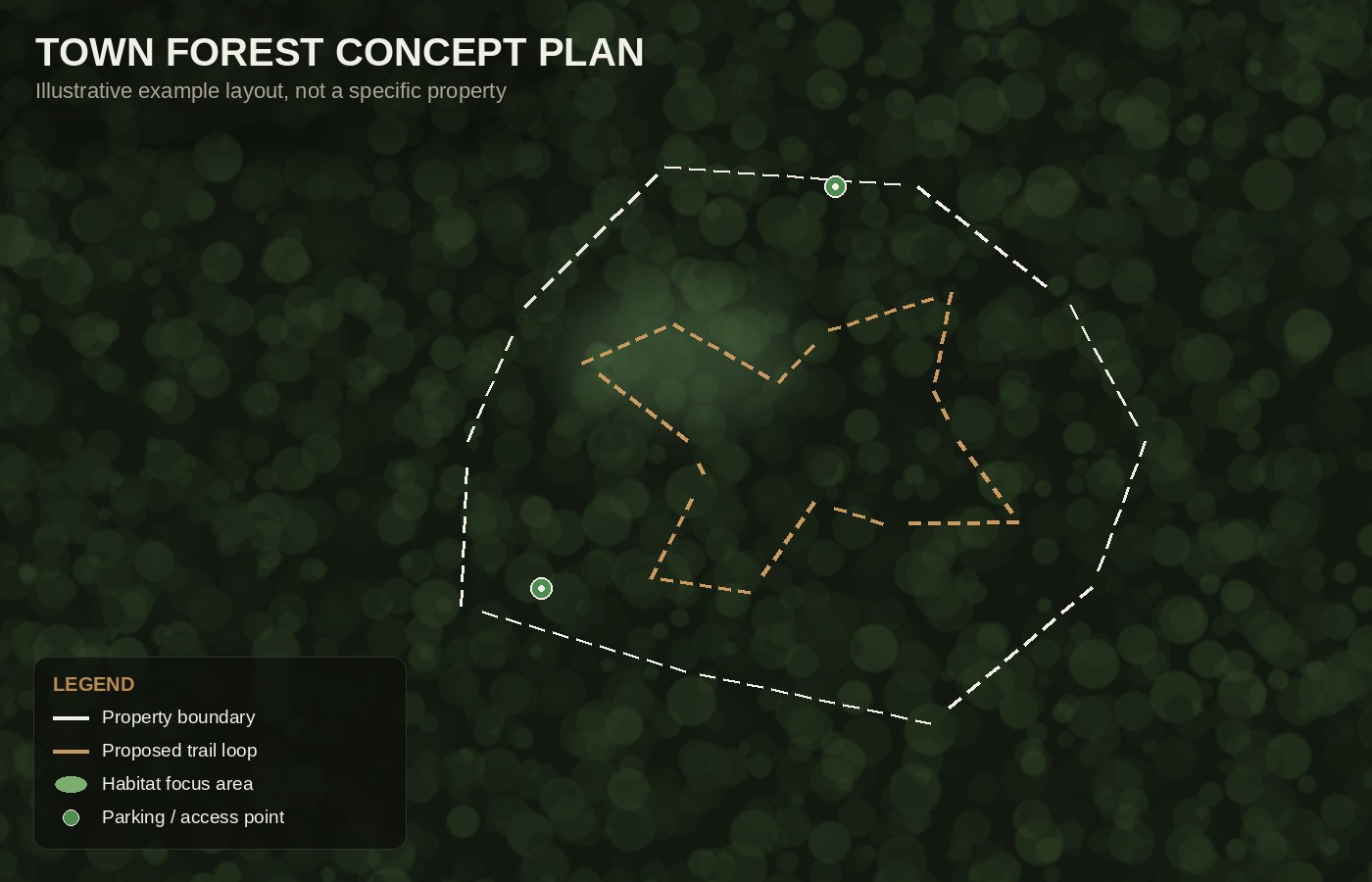
Layouts for trails, access, and habitat that respect existing use,
wildlife, and long-term timber value.
A town forest usually has to do several jobs at once: recreation,
timber income, wildlife habitat, watershed protection, and rarely has
a plan that accounts for all of them together. We build layouts that
work with existing trail use and community expectations, not against
them.
- Trail and access layout that respects existing use
- Habitat and timber value integrated into recreation planning
- Long-term management plans for conservation commissions
- Support for grant applications and land management plans
Storm resilience
Storm & Resilience Projects
Assess windthrow risk, wet spots, and access issues ahead of time so
the next big storm does less damage and is faster to clean up.
Most storm damage isn't random. Wet soils, shallow-rooted stands, and
compromised access corridors fail in predictable ways. Flagging that
ahead of time means a faster, cheaper cleanup instead of scrambling
for equipment access after roads are already blocked.
- Windthrow and wet-spot risk assessment before storm season
- Access corridor review for emergency response
- Post-storm damage assessment and cleanup sequencing
- Documentation to support recovery planning and funding requests
How we work with towns
Municipal projects move on public timelines and public budgets, and
they need to hold up to public scrutiny. We keep the process
straightforward: walk the site, document what we find in plain
language, and hand over something a committee or a budget hearing can
actually use.
- Walk the site with the road agent, DPW, or committee
- Document priorities in plain language, not just jargon
- Provide maps and notes that fit into bid packages and budgets
If you're a road agent, forester, or on a conservation commission and
want an outside set of eyes on a project, let's talk.